

Customer visit · Pakistan · Dates
Pakistan date processor audits the plant, puts FD-50E and FD-100E on trial
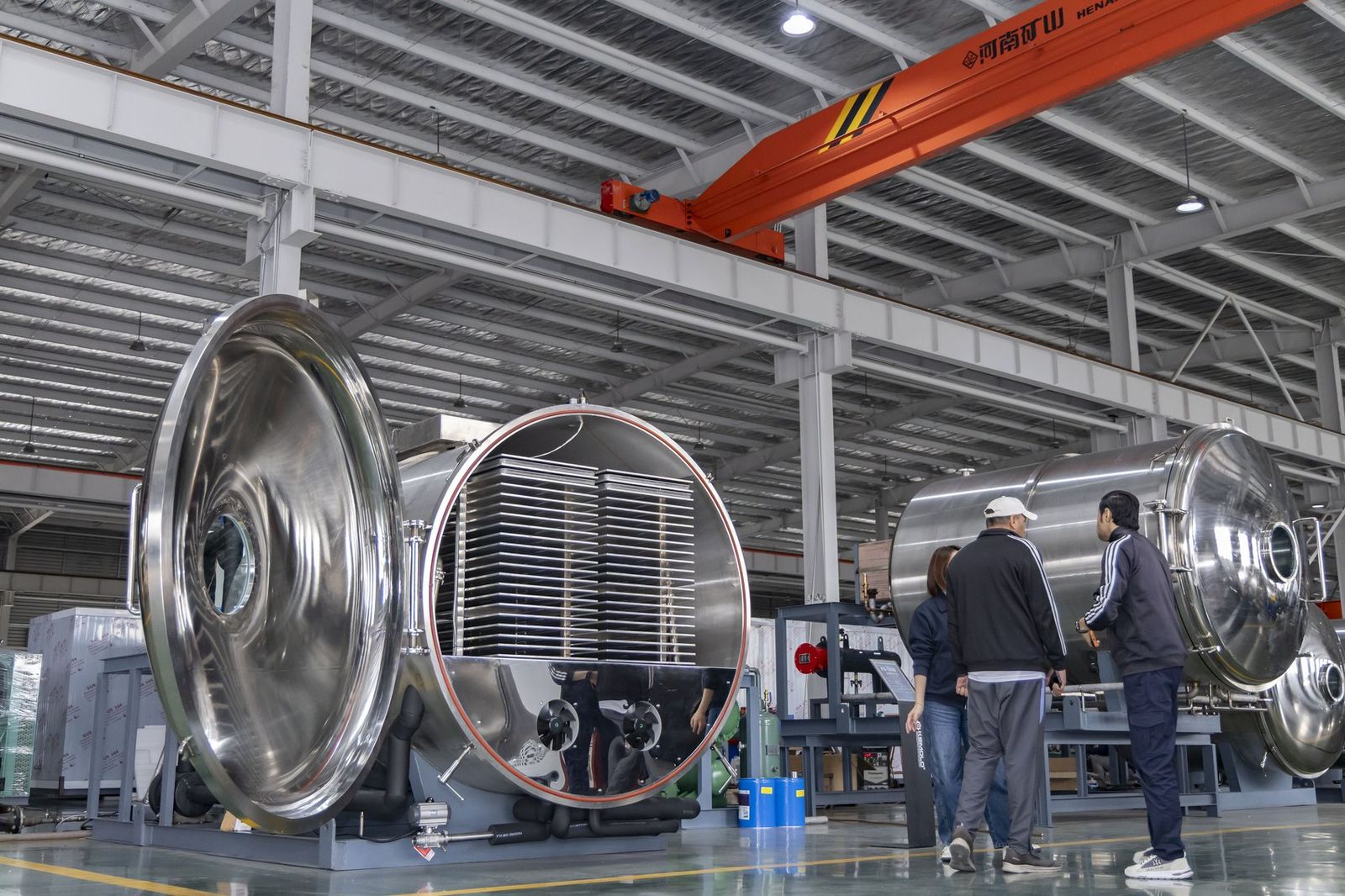
On 11 November 2026 a date packing and processing company from Pakistan spent the day at our freeze-drying equipment works — fabrication floor, machine internals, the final verification checklist — and left with a trial plan for freeze-dried whole dates.
11 November 2026
Factory audit
Factory audit
A purchase decided on the shop floor, not in a catalogue
A two-person delegation from a Pakistani date processing and packing business arrived on 11 November 2026 for a full pre-order factory audit. The company already sorts, packs and exports dates for domestic retail and overseas buyers; what it does not yet have is a freeze-dried line. Freeze-dried whole dates — no sugar, no preservatives, a crisp bite instead of the soft chew of a fresh pack — sit at a considerably higher price point than the conventional carton, and that is the product the delegation came to test.
The day began in the meeting room with a company presentation: build history, installed base, reference projects in fruit and vegetable processing, and the documentation package that ships with every unit. On screen was the final verification sheet, the Q5 checklist, and the delegation worked through it line by line — machine parameters against the contract, material certificates, plate and shelf thickness, piping layout, electrical components and the logic behind each control loop.
It is an unglamorous exercise, and that is the point. A freeze dryer is a pressure vessel wrapped around a refrigeration circuit and a vacuum train; the specifications that decide whether a dates line survives its first year of production are settled in the drawing package, long before anyone loads a tray.
The fabrication floor, opened up
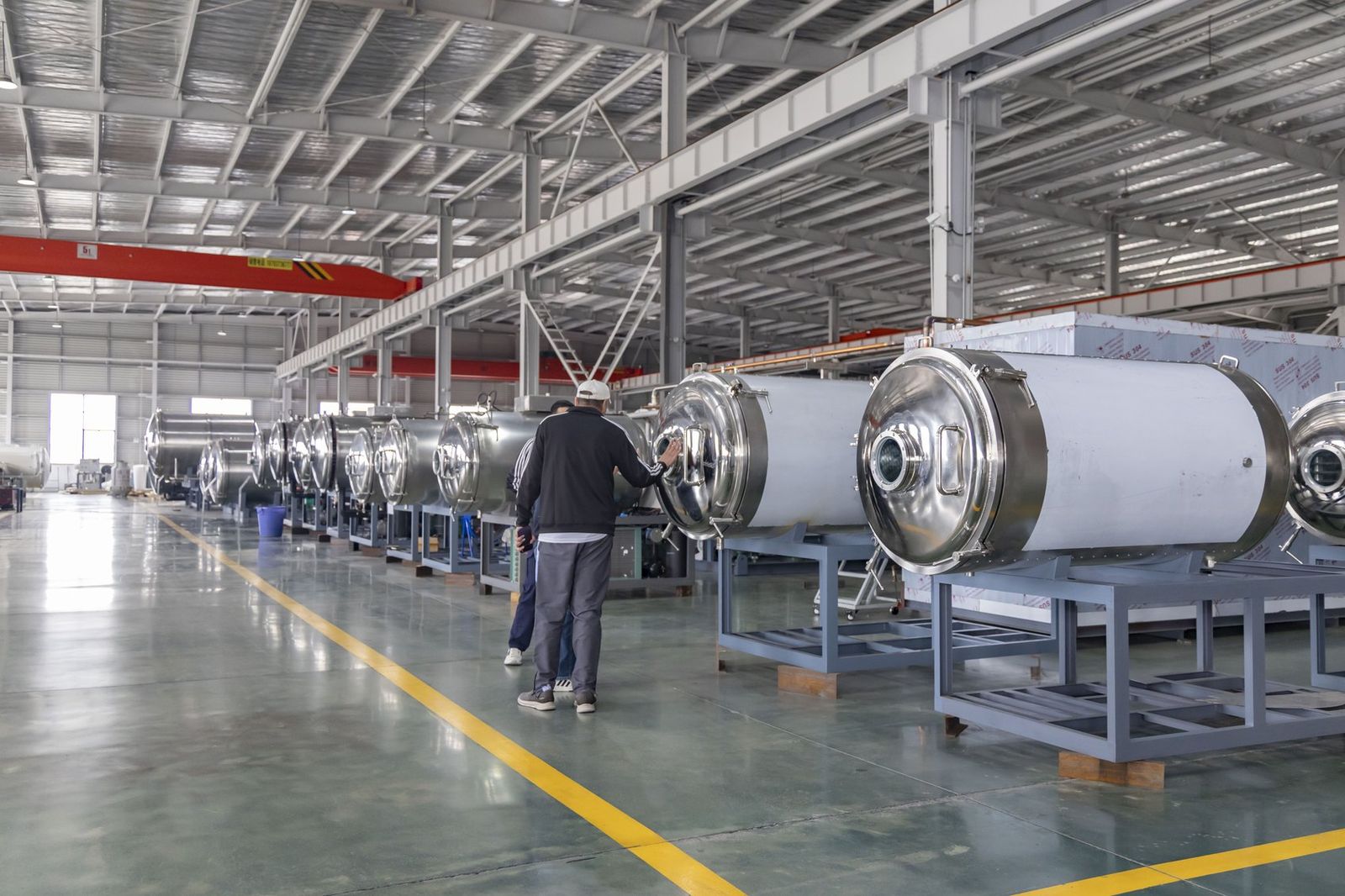
After the presentation the group moved to the fabrication floor, where rows of vessels sat at different build stages — shell only, skid-mounted, wired and ready for pressure testing. Doors were opened for inspection: hydraulic locking, the door seal, the sight glass, the tray racks and their spacing, the condenser coil behind the stack, the vacuum pump skid and refrigerant circuit. The delegation walked the tray stack with a torch, checking welds, passivation and the flatness of shelf surfaces — the details that later decide how evenly a load freezes and how cleanly it comes off the trays.
Nothing was taken on the brochure. Where a component was specified in the contract, it was found in the machine, and where it was not, the question went back to the engineering team for an answer on the spot.
“Dates are now one of the most frequent applications we are asked about from South Asia and the Middle East. Buyers rarely enquire about a single machine any more — they want the recipe, the trial data and the packing line to match.”
Export team, Kemolo Freeze Dryer Co., Ltd.What dates demand from a freeze dryer
Most of the technical conversation was about the fruit rather than the steel. Dates are sugar-rich and low in free water: total sugar commonly runs 60–70% of the flesh, and the skin is a genuine barrier standing in front of sublimation. Freeze too slowly and the ice crystals grow coarse, and the finished fruit collapses into a candy-like shell; pull vacuum too fast on a sticky, high-sugar load and the surface case-hardens while the centre is still wet.
So the discussion moved through three levers in sequence. Surface preparation first — whole fruit is pricked, or the skin lightly broken, so vapour has a path out. Then a deep-freeze stage held until the whole load is below its glass transition, because texture is decided in the freezer, not in the chamber. Then a stepped vacuum ramp instead of a single set-point, holding the load below its collapse temperature while the ice sublimes onto the condenser at 10–50 Pa.
The end-point is set by product temperature, not by a clock. That matters for a buyer who intends to run the same recipe on two different vessel sizes: a curve tuned to the smaller machine has to hold when the trays are full.
The trial plan
FD-50E takes the first pilot trays, where the recipe is fixed — freezing hold, ramp profile, end-point — against the customer's own fruit, from their own orchard and packhouse. FD-100E, the larger vessel of the pair, then runs the same recipe at full load to prove the result survives scale: even colour, retained shape, a crisp centre without a gummy core.
Residual moisture is the first number the customer will check. Freeze-dried dates are typically specified below 5%, which is what keeps whole fruit shelf-stable at ambient temperature in a sealed pouch with nothing added. Trial samples will be split — one set retained here for moisture, water activity and sensory checks, one set shipped to Pakistan for the customer's own packing and shelf-life trials.
What follows is a trial-run quotation covering both vessels, tray sets sized to the customer's carton format, sea freight to Karachi, installation and commissioning, and operator training on the recipe interface. Compliance files went into the same request: CE, EAC and CCC documentation, plus material certificates for food-contact 304/316L stainless. The purchase decision now waits on the samples.
Visit record
Three frames from the day · photographs by the export team

What the audit covered
Six areas checked against the contract — the same list the delegation will use again at the FAT.Contract parameters
Capacity, vacuum level, temperature range and utility consumption checked against the contract, the P&ID and the nameplate of the vessel.
Materials and finish
Food-contact 304/316L sheet, plate thickness at the shell and the shelves, weld inspection, passivation and surface roughness.
Vessel and door
Hydraulic locking, seal compression, sight glass and light port, shelf flatness and tray fit — the points that decide clean loading and unloading.
Refrigeration and vacuum
Compressor set and refrigerant circuit, condenser coil, vacuum pump skid, leak test and evacuation time on an empty chamber.
Control and recipe
PLC interface, alarm list and interlocks, recipe editing rights, and end-point logic driven by product temperature rather than elapsed time.
Compliance file
CE, EAC and CCC documentation, material certificates for food-contact parts, FAT report, operation and maintenance manuals, spare parts list.
Application: freeze-dried dates
From orchard fruit to a crisp, shelf‑stable snack
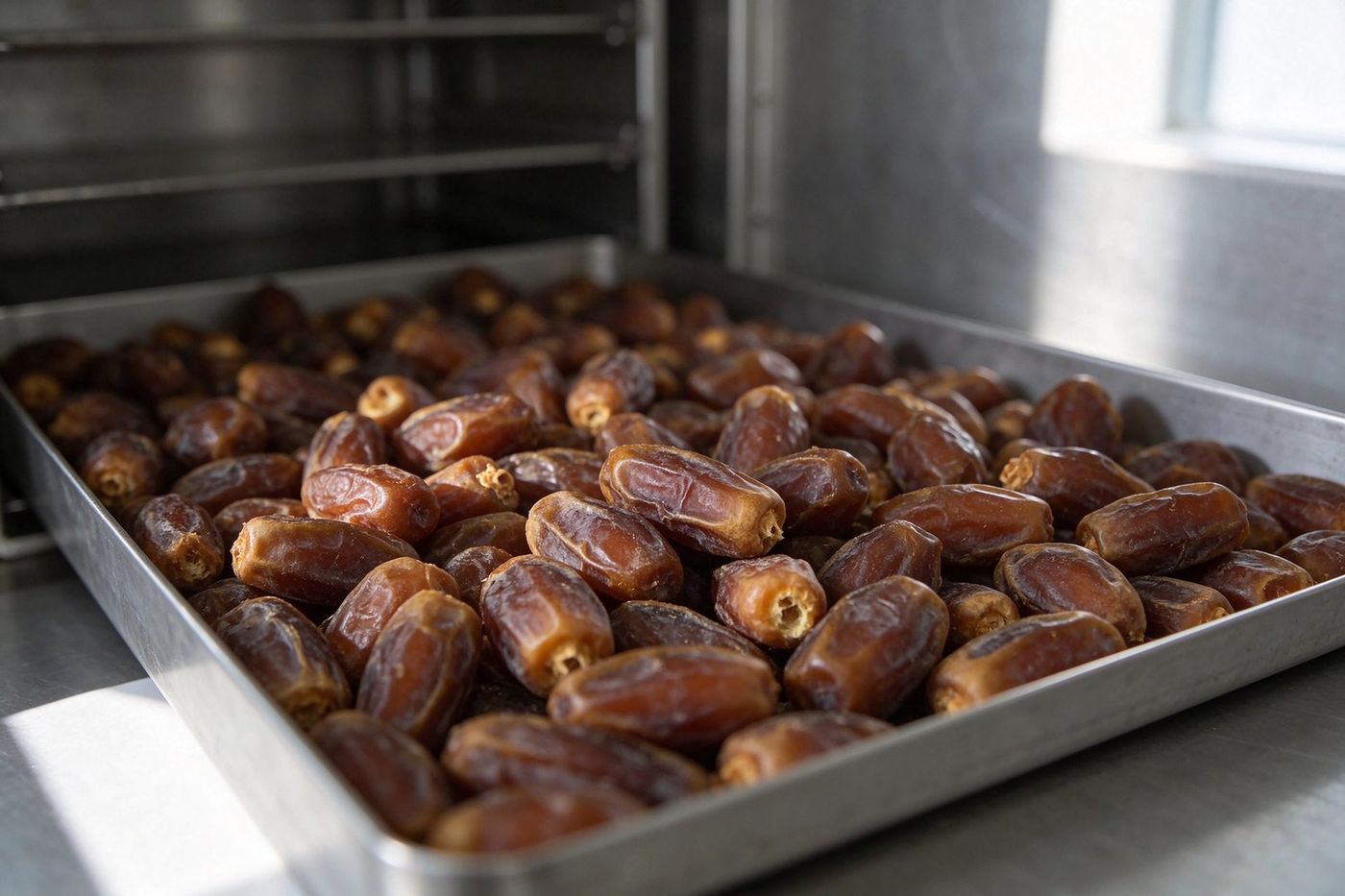
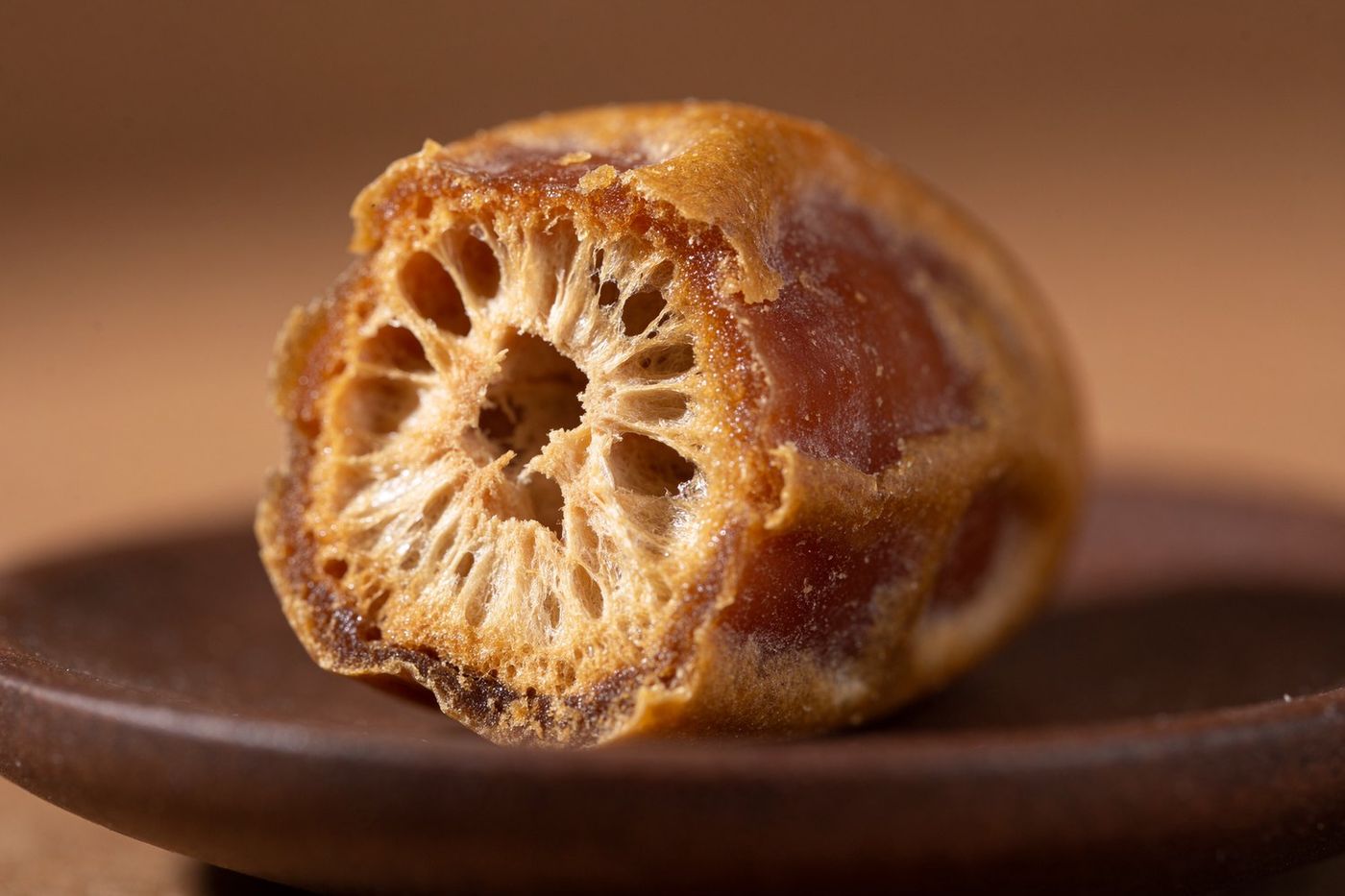
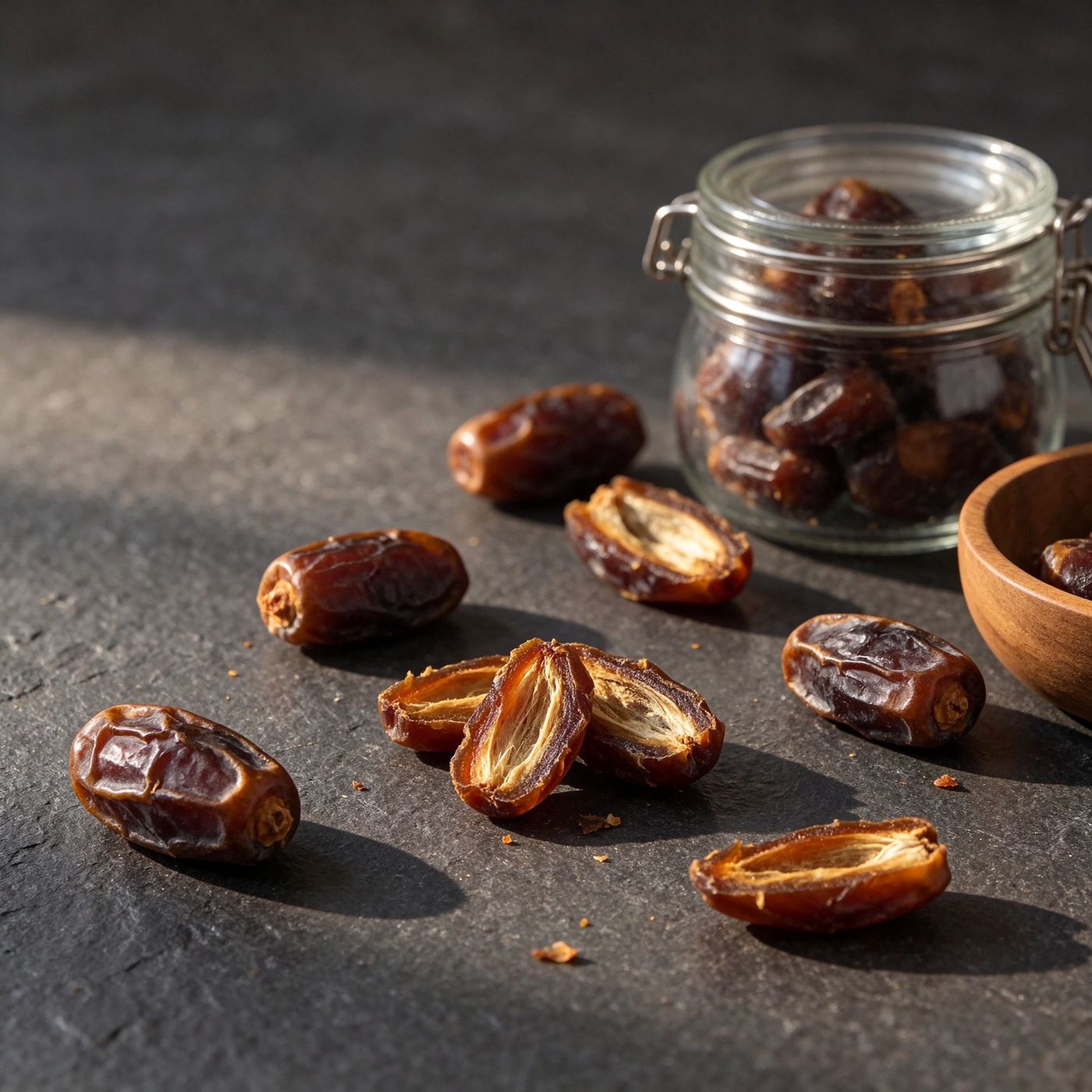
Freeze-dried dates keep the fruit whole: the stone stays in, the silhouette stays, the amber tone stays — and the bite turns crisp. Nothing is added and nothing is cooked out; the water leaves, and everything that makes the fruit taste like fruit stays where it was.
That is why the product commands a different price from a soft-packed carton, and why the customer came to test the curve rather than read a brochure.
01
Prep and loading
Dates washed and graded, the skin lightly broken (pricked or a thin peel), loaded in one layer so vapour has a path out of the fruit.
02
Deep freeze
The load is held below its glass transition until the whole batch is solid. Fine ice crystals here are what keep the texture from collapsing later.
03
Primary drying
Chamber evacuated to 10–50 Pa; ice sublimes and the vapour is trapped on the condenser. A stepped ramp holds the fruit under its collapse temperature.
04
Secondary drying
Bound water is removed to below 5%. Trays come out with whole, warm-toned fruit that snaps instead of bending.
Shape and colour retained
The fruit keeps its own silhouette and amber tone; edges do not darken the way they do in air drying.
Crisp, not gummy
An even honeycomb interior gives a clean snap. No leathery skin, no sticky centre after two months in the pouch.
Nothing added
No sugar, no syrup, no preservative. The sweetness is the fruit's own, at full concentration.
Ambient shelf life
Sealed below 5% moisture, the product travels and retails without a cold chain — a real advantage for export packing.
The two vessels on trial
FD-E range, horizontal cylindrical vessels with front-opening door. One proves the curve; the other proves it at load.Pilot vessel
FD-50E
Where the recipe is written. First trays, small commercial batches, and the curves that later move to the larger vessel.
- Vessel
- Horizontal cylinder, front-opening door, hydraulic lock
- Contact material
- 304 / 316L stainless, food-contact finish
- Shelves
- Tray racks, spacing set to product height
- Vacuum
- Operating range to 10–50 Pa
- Control
- PLC, editable recipe, product-temperature end-point
Production vessel
FD-100E
Same recipe, larger load — the machine a packhouse actually buys.
- Vessel
- Larger vessel of the pair, same door and locking system
- Contact material
- 304 / 316L stainless, food-contact finish
- Shelves
- Tray racks sized to the customer's carton format
- Vacuum
- Operating range to 10–50 Pa
- Control
- PLC, identical recipe interface to FD-50E
Tray count, shelf area and batch load are fixed per order, not per model name. Specifications, FOB price and delivery schedule are quoted against the configuration you need; compliance documentation (CE / EAC / CCC) ships with the vessel.
Questions buyers ask about freeze-dried dates
The four that came up in this audit, and the ones that arrive by email every week.Can a freeze dryer handle whole dates with the stone still in?
Yes, and most buyers prefer it — the stone keeps the silhouette. The skin is the limiting layer in front of sublimation, so whole fruit is pricked or lightly peeled before loading, and the primary stage runs longer than it would for sliced fruit.
Which model fits a dates line, FD-50E or FD-100E?
FD-50E is the pilot vessel: recipe development, first trays, small commercial batches. FD-100E runs the same recipe at production load. Buyers normally prove the curve on the smaller vessel and size the larger one to their annual output and carton format.
How long is one cycle?
Longer than for vegetables. For sugar-rich fruit the cycle length is set by the product-temperature end-point rather than a fixed clock, so the honest number comes from trial data on your own fruit — not from a table that assumes someone else's.
What does a freeze dryer for dates cost?
Price depends on vessel size, tray count, refrigeration and vacuum configuration, and the compliance package for your market. Export quotes can include sea freight, installation, commissioning and operator training, so the landed cost and the machine price are rarely the same figure.
Do you run trials on customer samples?
Yes. Send a sample of your own fruit; we run it on the pilot vessel and return the product, the curve and the moisture and water-activity results, so the decision rests on your material rather than on ours.
Related on this site
Everything the delegation asked for, in one place. Freeze-dried dates: process notes Four stages, from skin preparation to the sub-5% moisture end-point. FD-E series: FD-50E and FD-100E Pilot and production vessels, quoted per configuration. Trial runs on customer fruit How a sample becomes a curve, a moisture figure and a quote. What a factory audit covers The six areas checked on 11 November — reusable as an FAT checklist.
Test your own dates before you buy the vessel
Send a sample from your packhouse. We run it on the pilot vessel and return the product, the drying curve and the moisture data — the same pack the customer in this report will receive.
Request a trial run Ask for FD-50E / FD-100E FOB price sales@kemolo.com · WhatsApp +86 153 8002 4001 · reply within one working day