FD-5E
ValidationA small chamber sized for recipe work: enough tray area to fix freezing, drying and moisture targets on the customer's own extract, and enough output to fill sample orders while the recipe is still moving.

Plant visit report
A freeze-dried instant coffee producer from Indonesia walked the KEMOLO production hall, reviewed the trial results of its FD-5E and went through what an FD-500E or FD-1000E line would demand.
An Indonesian producer of freeze-dried instant coffee visited KEMOLO's manufacturing facility on 9 November 2026, reviewing the trial results of the FD-5E freeze dryer it bought earlier and working through the FD-500E and FD-1000E as the two candidates for commercial production.
The delegation was received by KEMOLO's technical and export teams. The day was split between the production hall and a technical session on capacity, utilities and the ramp-up schedule.
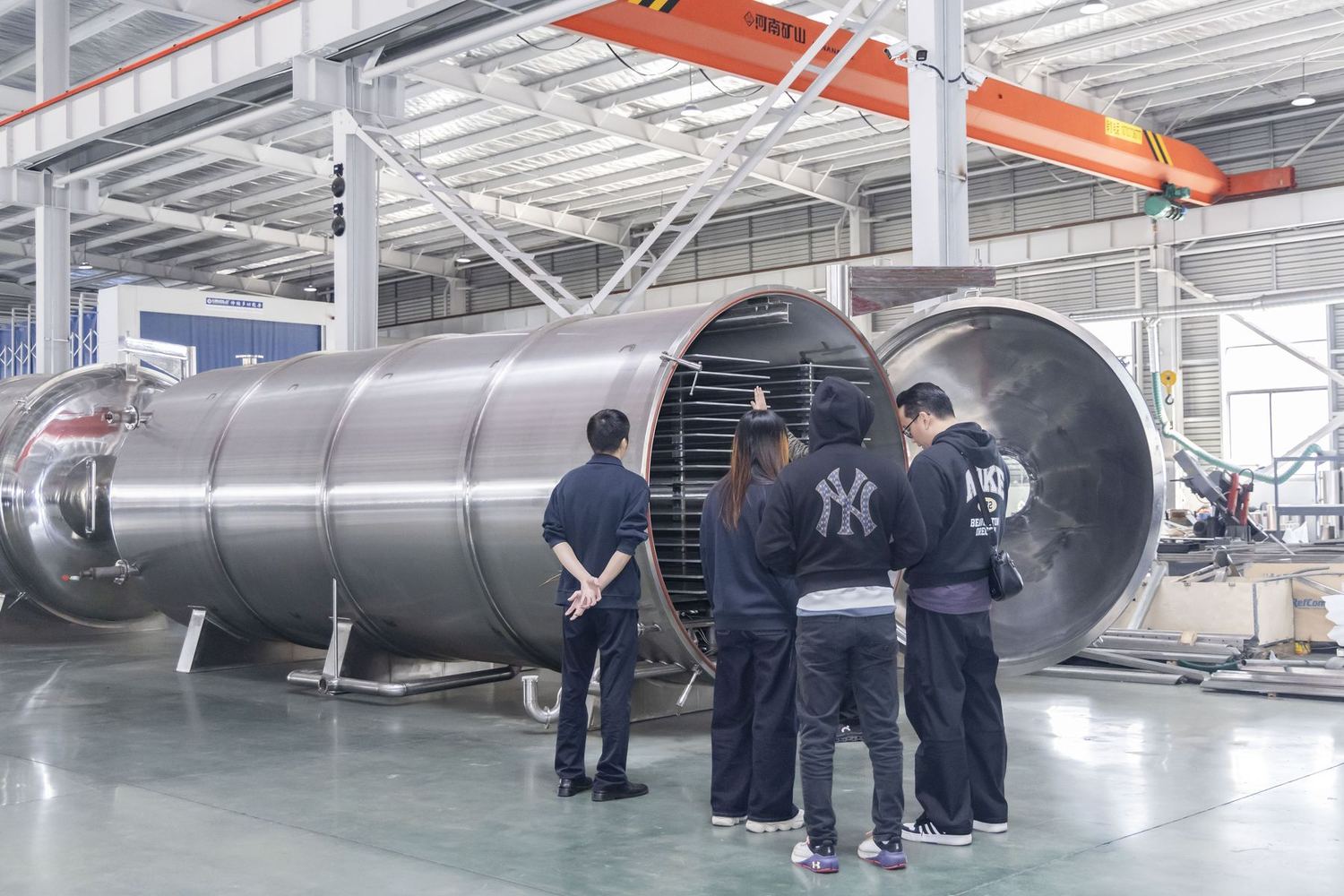
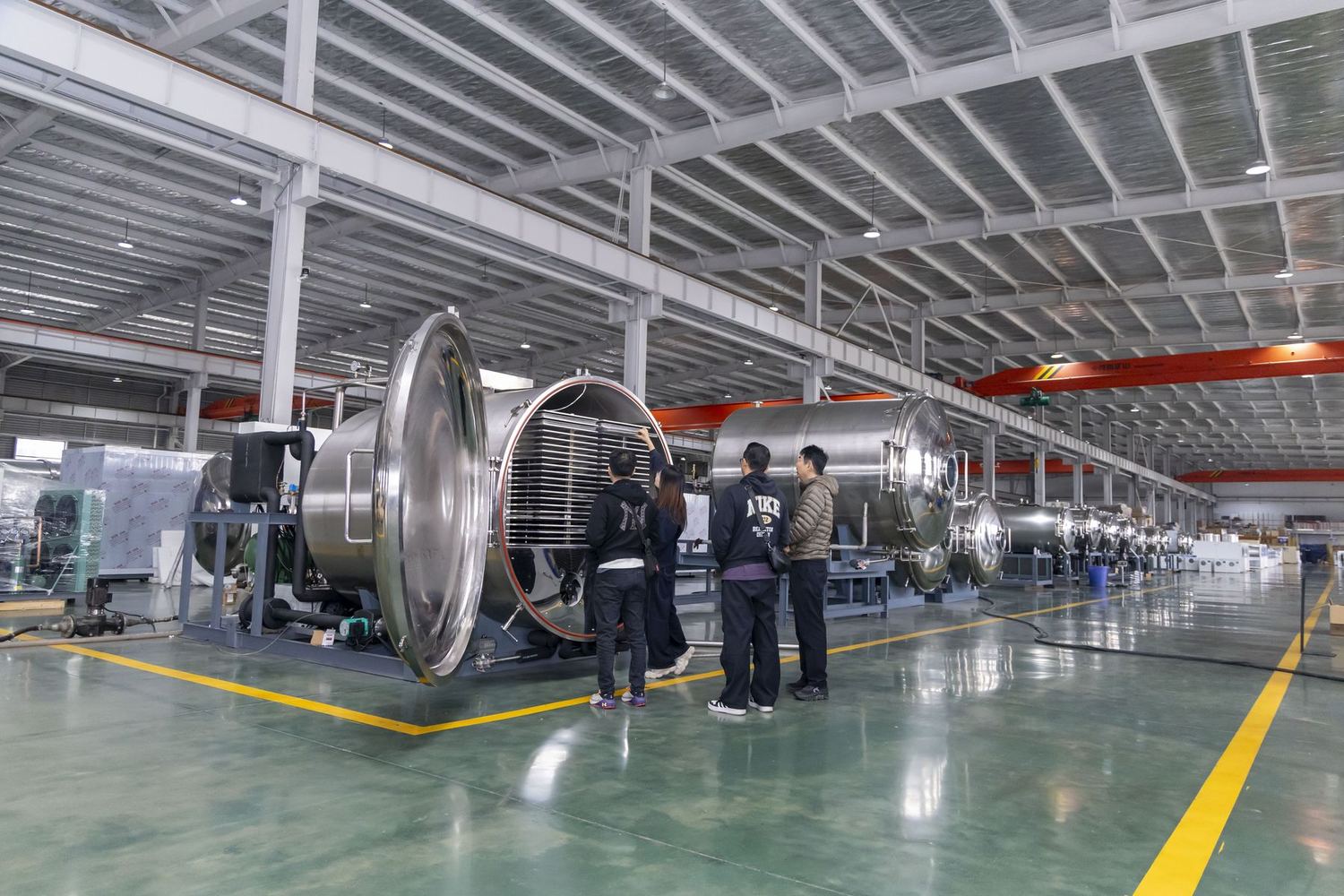
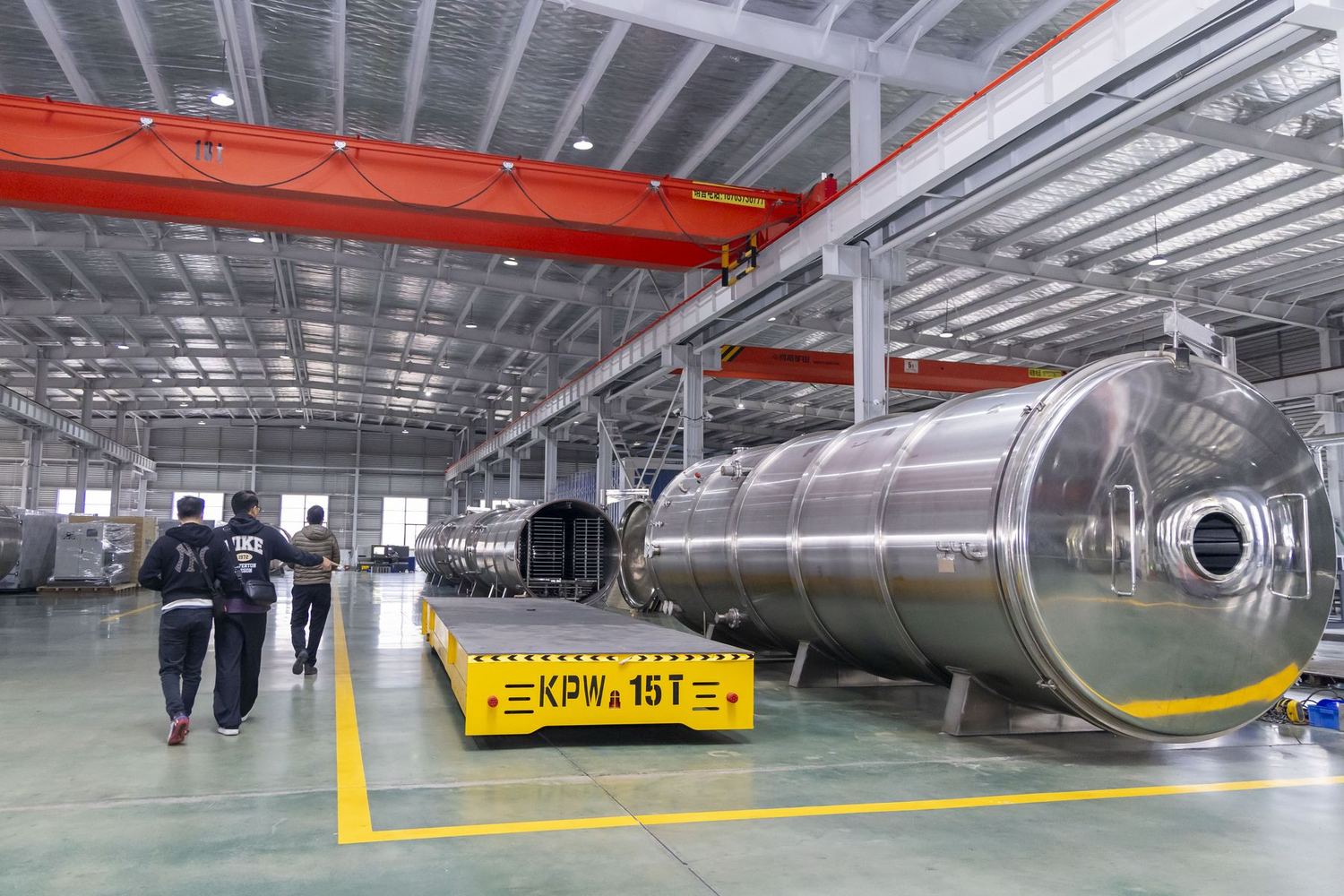
The tour started at the far end of the hall, where stainless chambers stand in rows at different stages of assembly — shells without doors, chambers with shelf stacks fitted, and finished units waiting on their skids for shipment. The client's engineers moved along the row from the open doors inward, checking shelf spacing, the door sill, and how the tray stack sits inside the chamber.
Most of what stands on this floor is far larger than the FD-5E the client already runs in Indonesia, and that gap is the substance of the discussion: the same drying principle, a very different load per cycle, and therefore a different set of site requirements.
From there the group moved to the refrigeration and vacuum assemblies, the control cabinets, and the commissioning bay where a unit is run before it leaves. The conversation stayed close to the question the client came with — what has to be true in the building, in the utilities and in the operating routine before a bigger chamber makes sense.
The FD-5E was bought as a validation platform rather than as production equipment: small enough to run the client's own extract in short cycles, large enough to produce samples that buyers can cup and approve.
Across the trial campaign the work concentrated on the four things that decide whether a freeze-dried coffee survives being scaled up. The first is the freezing step — how quickly the extract freezes sets the size of the ice crystals, and therefore the pore structure the vapour has to travel through during drying. The second is the pair of shelf temperature and chamber pressure during primary drying, which has to keep the sublimation front moving without the cake collapsing or the colour drifting at the edges of the tray.
The third is cycle length against load. A tray stack can be filled to the point where extra kilos stop paying for themselves in colour, aroma and moisture spread across the batch. The fourth is residual moisture: the figure that has to be hit for a product that sits on a shelf at ambient temperature rather than in a freezer.
Because the client roasts and extracts in-house, the trial also had to cover variation — different roast levels and extraction concentrations change bulk density, and a bulk density change moves the drying curve with it.
By the end of the visit both sides described the FD-5E results as meeting expectations: the unit covers recipe development, small-lot production and buyer samples, and the parameters it produced are now the input for sizing the next machine rather than a number to be re-derived from scratch.
KEMOLO's position on trial work is that a validation unit should be judged on what it lets a customer commit to — a fixed recipe, an approved sample and a defensible capacity figure — not on the throughput it delivers per hour.
The FD-5E, FD-500E and FD-1000E are not three sizes of the same purchase. Each answers a different stage of a freeze-dried coffee project, and the handover point between them is the trial data.
A small chamber sized for recipe work: enough tray area to fix freezing, drying and moisture targets on the customer's own extract, and enough output to fill sample orders while the recipe is still moving.
The step from validated recipe to commercial batches: a mid-size chamber that carries a fixed recipe into regular production without committing the building to a full volume line on day one.
Built for the case where the volume target is a multi-year number rather than a first-year one — fewer, larger cycles, with the utilities, tray handling and crane capacity sized around that load.
| If this describes your project | The model normally in play |
|---|---|
| The recipe is still open and buyers are waiting on samples | FD-5E |
| The recipe is fixed, volume is growing and one line has to carry it | FD-500E |
| The volume target is a multi-year plan and one installation has to absorb it | FD-1000E |
| You are deciding between the last two and have trial data in hand | FD-500E, reviewed against FD-1000E |
Batch capacity, tray area and utility figures are set per configuration and per product; they are quoted against a filled-in product sheet rather than read off a model name.
FD-5E installed and commissioned in Indonesia; the client's own extract becomes the test material.
Freezing profile, shelf temperature and pressure, cycle length and moisture target settled on the client's product.
FD-500E and FD-1000E compared on output target, building footprint, utilities and tray handling — the subject of this visit.
Equipment scheduled against the client's ramp-up, with the FD-5E staying in service for development and samples.
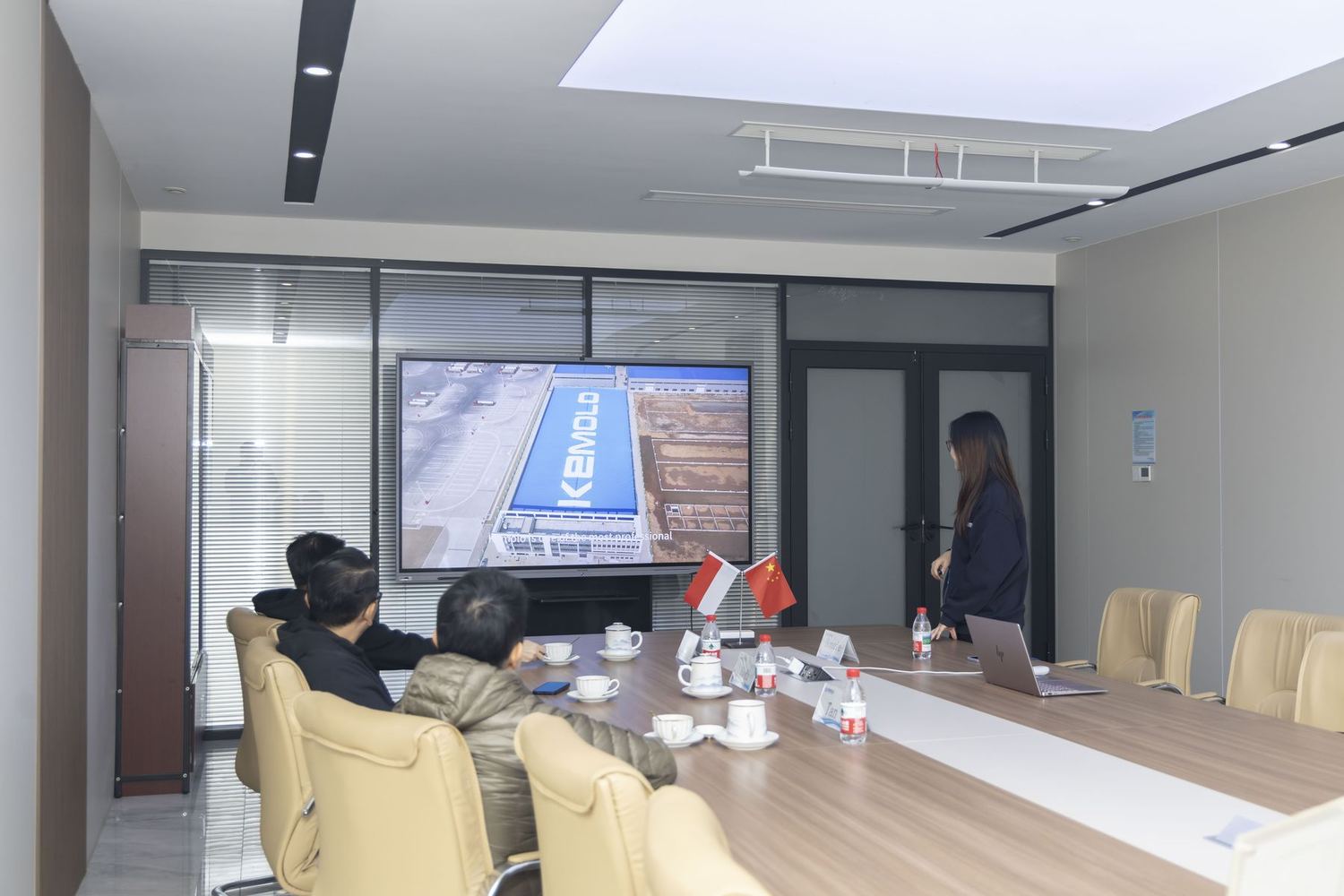
The afternoon moved indoors, where a screened aerial view of the plant was used to walk through layout from the outside in: where raw chambers arrive, where they are assembled, and what footprint each size class occupies once installed on the customer's site.
How a larger chamber sits in an existing building, including tray staging space and the route from dryer to packing.
Power load, chilled water or glycol, hot water or steam, compressed air, and where the condenser's heat goes.
Whether trays are hand-loaded, trolley-loaded or crane-assisted, and what each method costs in labour per batch.
Recipe storage, cycle logging and alarm history — the records a buyer's audit will ask for later.
The release schedule against the client's ramp-up, so that capacity arrives when the orders do.
Operator training on the client's own product, plus the first-year spare parts list and the wear items to stock.
Indonesia is one of the region's large coffee origins, with distinct profiles running from Gayo and Mandheling in Sumatra through Toraja and Java to the robusta belt in Lampung. Much of that crop leaves as green beans; the value that stays in the country depends on how far the bean is processed before export.
Freeze-drying is the process that keeps most of what roasting created. Because the extract is dried from frozen, at low temperature and under vacuum, the volatile aromatics that give coffee its character are less exposed to heat than in spray drying, and the granules rehydrate into a product that reads closer to brewed coffee. The result is also shelf-stable at ambient temperature, which matters for a producer selling into hot, humid markets and into export containers.
That is the commercial reason a producer starts with a validation unit rather than a full line: the recipe decides the value, and the recipe is cheaper to fix on a small chamber than on a large one.
Price is driven by batch size, cycle time, utility configuration and how much of the cycle is automated, so two plants with a similar chamber can land far apart. KEMOLO quotes against a filled-in product sheet — extract concentration, tray load, target output per day and the utilities available on site — rather than against a model name alone.
The FD-5E is a validation and small-batch unit. It is enough to lock a recipe, produce samples for buyers and run limited lots, and it stays useful after a larger machine arrives. It is not sized to carry a commercial volume target on its own.
From the trial data, the daily output target and the building. The drying curve from the FD-5E gives the cycle length per kilo; the sales plan gives the kilos; the building and its utilities then decide whether that load fits one FD-500E, needs an FD-1000E, or is better reached in phases.
Yes. Samples of extract or concentrate are run on a validation unit, and the trial reports back on cycle length, colour, aroma retention and residual moisture — the same four figures a scale-up decision is built on.
Power, chilled water or glycol, hot water or steam, compressed air, drainage, and a way to reject condenser heat. The figures per model come with the datasheet; the requirement that is most often underestimated is tray handling space in front of the door.
The FD-5E, FD-500E and FD-1000E are all supplied for export, with the documentation set, installation support and operator training arranged per project. Shipping, site preparation and commissioning are planned together so that the machine and the building are ready at the same time.
We return a model recommendation with the utilities, footprint and release schedule it implies. If you are earlier than that, send a sample and start on a validation unit.